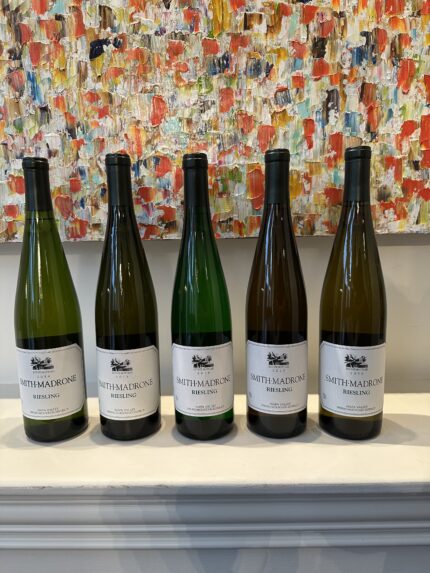
The first time I met Smith-Madrone Riesling, Napa and I were in a very different place. I was still early in my Dallas Wine Chick journey, still tripping over the line between “I love wine” and “I live wine,” and Riesling wasn’t the grape I was chasing. Then someone poured me a glass from a tall, quietly confident bottle from Spring Mountain, and my entire definition of Napa shifted a few degrees.

Stu at #wwet in Napa
I
t didn’t smell like what people thought Riesling should be—no cloying, sugary fruit bomb. Instead, it was lime zest, green apple, white peach, and this beautiful, stony note that felt like wet rock and mountain air. There was a tiny whisper of petrol, the kind that makes Riesling geeks smile, but it was more suggestion than shout. I remember thinking, “Wait…this is Napa?”
From that point on, Smith-Madrone Riesling became a sort of personal timeline wine for me.
2014–2016: The “Prove Everybody Wrong” Years
In those early years, I loved pouring Smith-Madrone Riesling for people who swore they “didn’t drink Riesling.” These were the folks scarred by bad, syrupy experiences in college or cheap restaurant lists. I’d pour a little into their glass, say nothing, and watch their faces change mid-sip.
The wine was laser-bright and energetic—lime, green apple, sometimes more crunchy pear in certain vintages, wrapped around acidity that felt like a clean line cutting right through Dallas heat. It tasted dry or just this side of it, with a long, mouthwatering finish, and always that mountain-etched minerality.
Those years, it was my “conversion” bottle. Backyard parties, casual tastings, girls’ nights—I’d slide it into the lineup and let it work its quiet magic. More than once, someone who previously avoided Riesling asked, “What was that, and where do I get it?”
2017–2019: The “Riesling as a Season” Era
By the time 2017 rolled around, Smith-Madrone Riesling had become part of my seasonal rhythm. Dallas summers can be soul-melting, and this wine might as well have been air conditioning in a bottle.
On those 100-degree days when turning on the oven felt like an act of aggression, I’d pick up takeout—Thai, Vietnamese, sushi, spicy tacos—and put a chilled bottle of Smith-Madrone Riesling on the table. It handled heat like a pro: bright citrus and stone fruit up front, that electric acidity, and just enough texture and weight to stand up to food without ever feeling heavy.
What started as, “Wow, this is a great Napa Riesling,” became, “I need a Smith-Madrone Riesling stash at all times.” The wines were consistent but never cookie-cutter. Some vintages leaned more citrus and green fruit; others brought a little more peach and roundness. The through line was always tension, minerality, and that unmistakable mountain edge.
During this window, the bottles I didn’t get around to right away started to age a little—and that’s when another layer of the story emerged.
2019–2022: The “Aging Gracefully” Chapter
If young Smith-Madrone Riesling is all about energy and precision, a few years of bottle age turn it into a deeper conversation. By the late 2010s and into the early 2020s, I pulled older bottles I’d been “saving for the right moment,” and suddenly I was kicking myself for not buying more to begin with.
The fruit shifted: still citrus and orchard fruit, but now with more developed notes—ripe peach, a little honeyed edge, maybe even a touch of lanolin and dried herbs. The minerality was still there, but it felt more integrated, less like a bright spotlight and more like a foundation the wine rested on. That gentle petrol character evolved, too—more complex, more savory, the kind of thing that makes you stop mid-sentence and go back to the glass.
The acidity, though? Still humming. That’s the beauty of these wines—they age, but they don’t fade. They gain depth without losing their spine.
These aged bottles became my “let’s talk” wines. They were proof that Napa Riesling—especially mountain-grown, dry-farmed Napa Riesling—could go the distance and tell a story years down the line.
A Constant in a Changing Wine World
Between 2014 and 2022, so many things in the wine world shifted—styles, trends, labels, the rise of “Instagram wines,” natural wine debates, you name it.
Instead, it stayed exactly what it was from the beginning: a mountain wine with attitude and honesty. The kind of bottle that respects your palate and rewards your patience.
For me, those years of drinking Smith-Madrone Riesling trace a quiet little arc in my own wine life—from skeptical to smitten, from “this is really good” to “I need this in my cellar, always.” It’s a wine that taught me not to underestimate Napa whites, not to pigeonhole Riesling, and not to overlook the quiet, stubborn producers who do things their way—year after year, vintage after vintage.