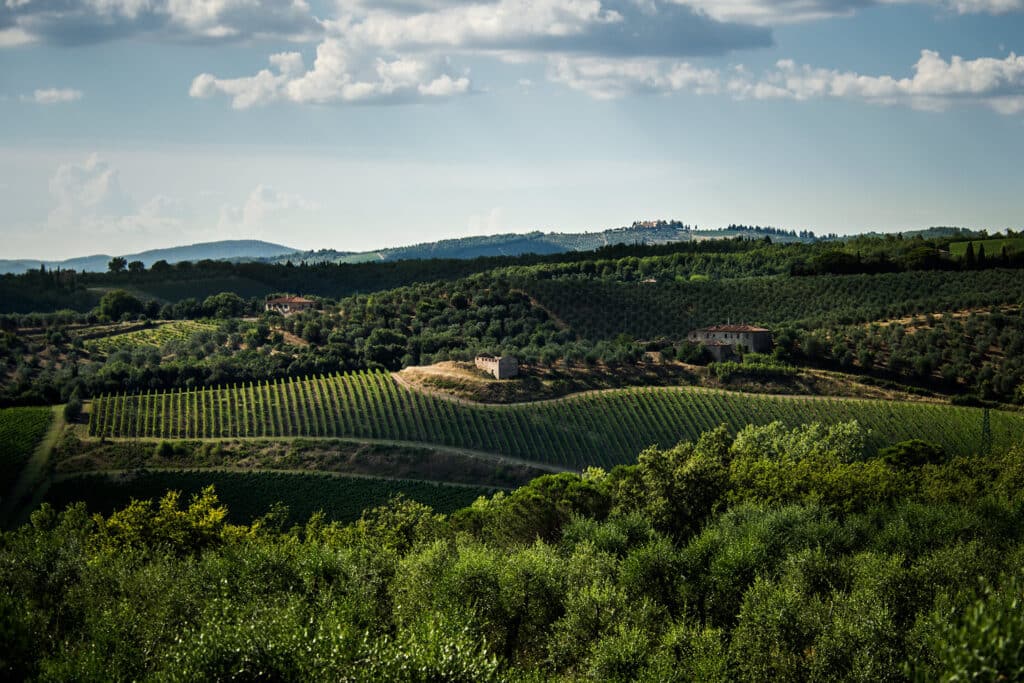
San Felice is one of those places that doesn’t just make wine. The stones, the cypresses, the slow Tuscan sunsets – everything feels in quiet harmony with Sangiovese. San Felice began as an ancient Tuscan hamlet and, over time, evolved into a modern wine estate that still feels like a village, with vines, olive trees, and people woven into the same fabric.
The San Felice story
Over the years, San Felice expanded beyond Chianti Classico into areas like Montalcino, but the soul remained anchored in the idea that wine is an expression of a living place. You taste that philosophy in the glass: structure without severity, fruit without flash, and this savory, herbal echo that feels like walking the vineyard rows just before dusk.
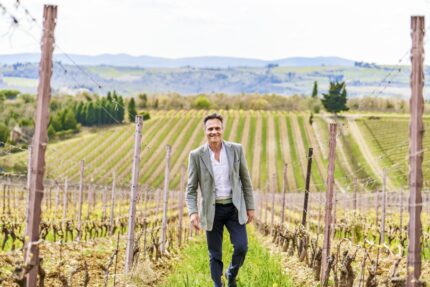
Enter Leonardo Bellaccini
At the center of that story stands Leonardo Bellaccini, long-time winemaker and quiet architect of San Felice’s modern style. He is known for treating Sangiovese not as a monolith, but as a family of personalities, using careful parcel selection and blending to craft wines that are precise yet soulful.
Those elements become characters in San Felice’s ongoing narrative until the 1960s. Following its sale in 1967, significant investments led to vineyard expansion and modernization, resulting in the production of approximately 1 million bottles, primarily focusing on Chianti Classico and other prestigious wines. Leonardo highlighted the evolution of winemaking in Tuscany, particularly the transition from quantity to quality, and the significance of the Super Tuscan category, especially the Vigorello wine. He recounted his personal journey from studying agriculture to becoming the estate manager and winemaker at San Felice, while also noting the winery’s role as a wine resort that offers hospitality experiences.
Talking with Leonardo about San Felice is like paging through a family album of Tuscan wine. He traces the roots back to the early 1900s, when the estate was part of the Gallonero consortium and farming ran on the old sharecropping system that defined rural Tuscany until the 1960s. You can almost see the shift when the property was sold in 1967 and serious investment followed. Vineyards were replanted and expanded, the cellars were upgraded, and San Felice began its transformation from rustic farm to a modern estate capable of producing around a million bottles a year without losing its soul.
In his conversations, Leonardo often circles back to balance between innovation and heritage, science and instinct, vineyard and cellar. He speaks of native grapes and field research not as marketing points, but as tools to keep Tuscany’s voice recognizable in a world that often chases sameness.
Leonardo would talk about walking the vineyards season after season, watching how each parcel reacts to heat, rain, and the stubborn unpredictability of nature, and how those years of observation shape every blending decision.
And then there’s the part that speaks to the traveler in all of us. San Felice is not just a winery, it’s a full‑fledged wine resort. Leonardo lights up when he talks about guests waking up among the vines, wandering down to taste Chianti Classico and Super Tuscans where the grapes were born, and understanding that this place was once a working sharecropping village. It’s that blend of history, hospitality, and seriously good wine that makes San Felice feel less like a stop on a Tuscan itinerary and more like a chapter in your own wine story.
Leonardo’s personal path into this world feels humbly at odds with the scale of what he now oversees. He started by studying agriculture, more interested in soils and seasons than stainless steel, and first joined San Felice in the lab before moving into the cellar as winemaker and eventually stepping up as estate manager. His kids, he laughed, chose other careers, so the continuity here is less about bloodline and more about a deep, chosen commitment to this patch of earth and its grapes. There’s gratitude in the way he talks about it—a sense that he knows he’s been handed a piece of Tuscan history and asked not to break it.
Leonardo’s dual role of estate manager and winemaker means he isn’t just thinking about what’s in the tank; he’s constantly balancing tradition, experimentation, and the expectations of a global audience that now looks to San Felice for benchmark Chianti Classico.
More about San Felice
San Felice sits in the heart of Chianti Classico, a patchwork of vineyards and woodland where elevation, rocky soils, and that essential Tuscan light all conspire to give Sangiovese its nerve and elegance. The estate became truly known for its commitment to research and tradition side by side, especially its pioneering work with native grapes and clonal selections that pushed Chianti Classico quality forward while keeping a firm grip on identity.
Over the years, San Felice expanded beyond Chianti Classico into areas like Montalcino, but the soul remained anchored in the idea that wine is an expression of a living place, not a stylistic costume. You taste that philosophy in the glass: structure without severity, fruit without flash, and this savory, herbal echo that feels like walking the vineyard rows just before dusk.
In his public conversations, Leonardo often circles back to balance: between innovation and heritage, science and instinct, vineyard and cellar. He speaks of native grapes and field research not as marketing points, but as tools to keep Tuscany’s voice recognizable in a world that often chases sameness.
What makes the story compelling is how closely it mirrors Tuscany’s evolution from bulk producer to quality‑obsessed benchmark. Leonardo talks about the region’s pivot away from quantity and toward character and precision, and San Felice sits right in the middle of that narrative. The estate embraced the new energy around quality winemaking and played an important role in the rise of Super Tuscans, with Vigorello (so good!) becoming one of those game‑changing wines that pushed beyond traditional rules and helped reframe what Tuscan reds could be.
And then there is San Felice as a wine resort. Guests sleep where sharecroppers once lived, wake up to stone walls and cypress silhouettes, and then wander a few steps to taste Chianti Classico, Super Tuscans, and native‑grape blends where they were born.
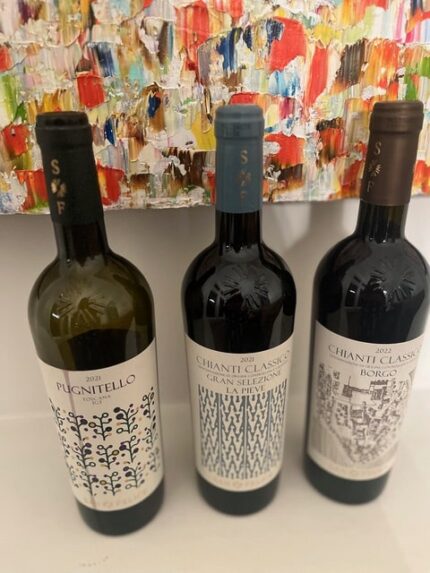
San Felice is the kind of place that stays with you long after the last glass is poured – a former sharecropping hamlet turned wine estate and resort, where history, research, and hospitality all revolve around the many voices of Sangiovese. In Leonardo Bellaccini’s hands, Chianti Classico and the estate’s Super Tuscans don’t feel like “styles” so much as translations of this landscape: precise yet generous wines that carry the rocky soils, Tuscan light, and decades of quiet experimentation in every sip.