Troon Vineyard is no longer the “promising comeback kid” I first wrote about; it’s the grown-up, fully realized version of that vision, and it’s wearing its regenerative crown without apology.
Looking back at where we left off
When I last wrote about Troon in early 2022, the story was about an estate mid-metamorphosis — a once-tired property being rebuilt vine by vine under Craig Camp’s leadership. Replanting was well underway, the shift to organic and biodynamic farming was the heartbeat, and there was this electric sense of potential in the air. It felt like we were watching the pilot episode of a series.
Fast-forward to today, and that potential has turned into a fully developed character arc. Troon isn’t talking about what it wants to become anymore; it’s living it in the soil, the cellar, and in the glass.

From sustainability story to regenerative benchmark
Troon Vineyard has moved from “sustainability standout” to full-on regenerative case study, and the receipts are all over its certifications. The estate is certified organic and Demeter biodynamic, but the real headline is its early and deep embrace of Regenerative Organic Certification — first as a pilot winery, then as one of the first in the world to achieve ROC, and eventually ROC Gold across soil health, animal welfare, and social fairness. Troon was the first estate farm in Oregon and only the second winery globally to earn ROC status, then one of just four farms worldwide in the inaugural group to hit ROC Gold, which means those labels now carry some of the most meaningful sustainability logos in wine.
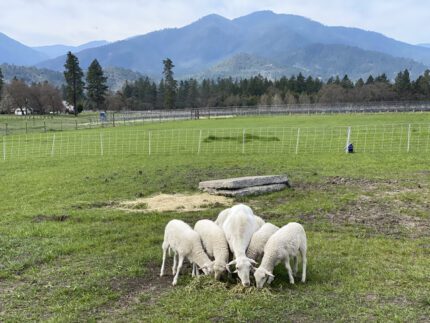
That might sound like alphabet soup, but on the ground it means a farm that functions more like a living ecosystem than a simple row of vineyard plants. We’re talking about biodiversity plantings, integrated animals, compost and soil-building efforts that go far beyond just “no herbicides” and focus on “how do we make this place healthier each year?”
The vineyard and the farm that finally match the vision
One of the biggest shifts is just how complete the physical transformation now feels. Troon has replanted all 50 acres of vines on its 100-acre property, dialing in varieties and rootstocks to match the Applegate Valley’s granitic and river-influenced soils rather than forcing a one-size-fits-all Oregon formula. The result is a patchwork of carefully chosen Mediterranean and Rhône varieties that make a lot more sense in this sunny, wind-kissed corner of Southern Oregon.
The language on the farm has also changed — it’s less about “vineyard” and more about “estate.” Cover crops, animals, and diverse plantings now feel woven into the identity, not bolted on as a sustainability talking point. You get the sense that Troon has traded the idea of being a winery with a nice backstory for being a farm that just happens to make some very compelling wine.
Inside the cellar: concrete, texture, and confidence
Walk into the cellar now and you can see the evolution in the hardware and the mindset. New concrete fermenters and a concrete dolium arrived ahead of the 2023 harvest, and they’re no longer experiments—they’re core tools. Vermentino, in particular, has become a concrete star, with fermentation and aging in these vessels adding texture and a salty, linear edge that lines up beautifully with Troon’s acid-driven style.
You see similar moves on the red side, where concrete plays a bigger role in the élevage of blends and helps showcase freshness and spice over weight and oak. This is not a winery chasing power; it’s leaning into energy, savory notes, and drinkability, the kind of bottles that make you reach for the next glass before you’ve finished the first.
The Druids arrive: a new calling card
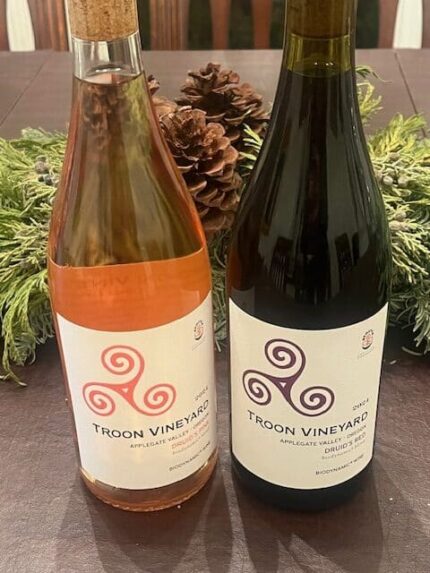
If there’s a clean narrative handoff from “transformation” to “arrival,” it’s the Druid’s line of biodynamic blends. Years of replanting, farming changes, and blending trials finally culminated in the launch of Druid’s Red, White, and Rosé, with the 2023 Druid’s Red as a clear statement of intent.
Druid’s Red pulls together Rhône and Mediterranean varieties like Syrah and Carignan, uses some whole cluster, and sees about a quarter of the blend fermented and aged in concrete. The wine reads like a Troon manifesto in a bottle: bright yet grounded, herbal and savory, textured without heaviness. It’s the kind of wine that feels undeniably Applegate, but also unmistakably Troon — a signature more than a category.
What’s changed in the story I’m telling
When I first wrote about Troon, the narrative was about a winery in the messy, exciting middle of reinvention: new ownership, new farming, new vision, and a lot of hard work left to do. The hook was possibility and the courage to tear it all down and start again.
Now, the hook is proof. Troon is an ROC Gold, certified organic, biodynamic estate that has replanted its vineyards, reshaped its identity, and leaned into concrete, lower-alcohol, savory, textural wines that speak with a confident house voice. The estate that once asked, “What if we did everything differently?” is living the answer—and inviting the rest of the wine world to catch up.
Troon Vineyard doesn’t feel like a prediction anymore; it feels like a preview of what the future of winegrowing can be. The estate has moved beyond the language of goals and intentions into a place where farming, winemaking, and philosophy are all pulling in the same direction. You taste the proof that reinvention, when it’s rooted in the soill can actually deliver on its promises.